


Custom connector marking is a precision problem. When a connector leaves your facility with a customer's logo, part number, or unique identification requirement, that mark must be legible, permanent, and repeatable across every unit in the run — whether you are stamping fifty terminal strips or 50,000 heat shrink sleeves.
For electronics assemblers and interconnect distributors offering value-added services, connector marking is often the difference between winning and losing a contract. Customers expect their specifications met exactly. That puts real pressure on the marking tools themselves — the type, the dies, the foil compatibility, and the supplier who makes them.
This post covers the main connector marking methods used in electronics assembly, how to choose between brass and steel type, what to expect from custom logo dies for terminal strips and heat shrink connectors, and what Heilind Electronics — one of the largest interconnect distributors in the United States — looks for in a marking products supplier.
What Is Connector Marking and Why Does It Matter in Electronics Assembly?
Connector marking is the process of applying permanent, legible identification — including numbers, alphanumeric text, logos, and part-specific codes — directly onto electrical connectors, terminal strips, heat shrink sleeving, and related components. It is a core requirement in value-added electronics assembly, where custom specifications drive product differentiation.
In electronics manufacturing and interconnect distribution, connectors rarely ship as generic parts. OEM customers and end users often require components marked with their own part numbers, proprietary logos, circuit identification codes, or regulatory markings before the product is considered complete. The mark itself becomes part of the product's traceability and quality record.
The stakes are real. A connector that arrives at a customer's facility without the correct marking — or with a mark that smears, fades, or fails to meet the agreed specification — creates rework, delays, and in some industries, compliance failures. Aerospace, defense, medical devices, and industrial automation applications all have strict requirements around connector identification. Getting the marking wrong costs far more than getting it right from the start.
The marking tools used in this process — brass and steel type for pad printing and hot stamping, custom logo dies for terminal strip identification, and specialized foils for heat shrink applications — are precision manufacturing components in their own right. The quality and accuracy of those tools determine the quality and accuracy of every connector that leaves the line.
What Materials Are Used in Connectors and How Does That Affect Marking?
Connectors are manufactured from brass, aluminum, steel, and a wide range of thermoplastic and thermoset materials. Each substrate responds differently to marking processes, which means the right type or die material and process parameters depend directly on what the connector is made of.
Metal connector bodies — particularly brass and aluminum — are common in industrial, military, and high-frequency applications. These materials respond well to hot stamping when the die and foil combination is matched to the surface. Aluminum requires more attention to temperature and dwell time than brass connector bodies, which tend to be more forgiving. Steel connector housings and backshells are harder substrates that benefit from steel type rather than brass when high-cycle production runs are involved.
Thermoplastic connector bodies are the most common in commercial electronics. Materials like nylon (PA), PBT, PVC, polypropylene, and polyolefin-based housings make up the majority of connector bodies across connector families from subminiature to heavy-duty industrial. These plastics vary significantly in surface energy, which affects how well a foil impression bonds. Lower surface energy plastics, like polypropylene, require higher temperatures and careful foil selection. PVC and nylon housings are generally more receptive to hot stamping and tend to produce clean, consistent impressions when parameters are dialed in correctly.
Heat shrink tubing — used extensively for wire and cable identification — adds another layer of complexity. Cross-linked polyolefin heat shrink requires foil formulations specifically developed for that substrate. Standard foils that perform well on rigid plastics may not adhere properly to recovered heat shrink sleeving. This is a common problem for assemblers who use the wrong foil or the wrong type and wonder why their marks are failing adhesion tests.
Durable Technologies collaborates directly with customers to match die material, foil chemistry, and process parameters to the specific connector substrate — a step that matters more than most buyers expect when they're sourcing marking tools for the first time.
How Does Pad Printing Type Work for Connector Identification?
Pad printing type for connector marking is precision metal type — typically brass or steel — set into a type holder that feeds into a pad printing or offset printing press. The type transfers ink through a silicone pad that conforms to irregular connector surfaces, making it well-suited for curved, recessed, or contoured connector bodies where a flat hot stamping die cannot make uniform contact.
The fundamental advantage of pad printing over direct hot stamping in connector applications is its ability to mark non-planar surfaces. A circular connector backshell, a curved housing, or a connector body with molded ribs or recesses can be marked consistently with pad printing in a way that hot stamping cannot easily replicate. The silicone pad deforms to match the surface geometry on every cycle, producing consistent ink transfer across the entire mark area.
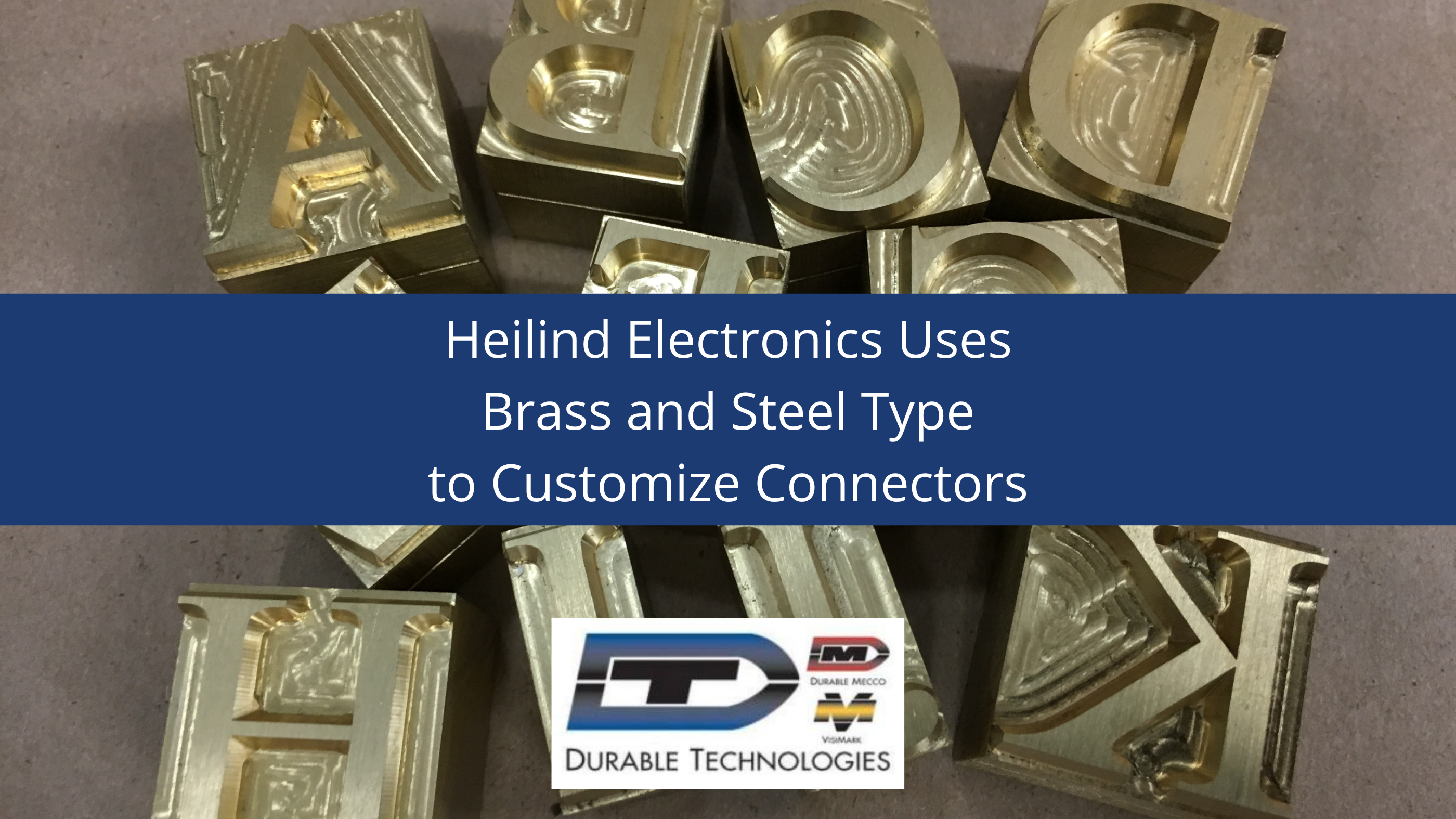
Brass printers' type for pad printing applications is available in a wide range of font styles, character sizes, and body heights to fit different press configurations. Type sets can include alphanumeric characters, symbols, and custom characters cut to the customer's specification. For connector marking applications, character sizes tend to run small — legibility at 1.5mm to 3mm character height is a common requirement in electronics, particularly on smaller connector families.
Steel type is used when the application demands higher production volumes or when the substrate is aggressive enough to accelerate brass wear. The tradeoff is cost per character — steel type costs more upfront but extends replacement intervals significantly in high-cycle environments. For a value-added connector distributor running thousands of marked connectors per week, that difference in die life directly affects cost per unit.
Durable Technologies manufactures brass and steel printers' type in News Gothic and News Gothic Condensed styles available for same-day shipping, with a broad inventory of all-purpose straight body type for hot stamping, coding, and imprinting. Custom type in alternate font styles and character sizes can be produced to spec.
What Are Custom Hot Stamping Dies for Electronics Connectors?
Custom hot stamping dies for electronics connectors are precision-engraved metal dies — manufactured from brass, steel, or magnesium — used to transfer a permanent impression onto connector bodies, terminal strips, or heat shrink identification sleeving using a heated press. The die face carries the exact text, logo, or part number required by the customer's specification.
The hot stamping process is straightforward in principle. The die is mounted in a hot stamping press, heated to the temperature required by the substrate, pressed against the connector surface with foil between the die face and the part, and released. What remains is a permanent, foil-colored impression of whatever was engraved into the die. In practice, getting that impression right across thousands of connectors requires dies machined to tight tolerances and foils matched precisely to the substrate.
Custom logo dies are the most common type of connector marking. Where variable data like part numbers or sequential codes are required, those characters are typically composed from individual type characters in a type holder, giving operators the flexibility to change copy between runs without ordering a new die. Fixed logos and branding marks, by contrast, benefit from a single-piece custom die that can be loaded and run without composition, reducing setup time and eliminating the possibility of transposition errors in the type chase.
Die design matters as much as die material in electronics connector applications. Small character sizes, fine line weights in logos, and tight spacing between elements all put demands on the engraving process. A die that looks acceptable under normal inspection can produce fills and bridging problems under magnification if the engraving wasn't executed with the right cutter geometry and depth. For applications where marking quality is evaluated under 10x magnification — common in aerospace and medical connector programs — the quality of the die cutting is not a secondary concern.
Durable Technologies produces custom hot stamping dies from customer-supplied artwork in Adobe Illustrator, DWG, DXF, and EPS formats, reviewing designs for manufacturability before cutting begins. That upfront review step catches issues that would otherwise show up in the first production run.
Brass or Steel Type: Which Is Right for Your Connector Marking Application?
Brass type is the right choice for most connector marking applications involving moderate production volumes and softer substrates like PVC, nylon, and standard polyolefin. Steel type is the better choice for high-volume runs, harder engineered plastics, and applications where die longevity is a primary cost driver.
Brass has been the standard material for hot stamping type in electronics and interconnect applications for decades, and for good reason. It machines to fine tolerances, holds detail well, conducts heat evenly across the die face, and far outlasts the softer alloys — zinc and lead type — that were common in older printing applications. For a value-added connector assembler running mixed jobs with different copy requirements and changing customer specifications, brass type offers the flexibility and affordability that keep job changeovers practical.
The comparison point that matters most for procurement and engineering contacts evaluating type quality is not brass versus alloy — it is brass versus cheap alloy. Zinc and lead type wear faster, mark less crisply, and require more frequent replacement. Brass type produces a sharper, cleaner impression from the first mark to the last mark in a run, which is exactly what a customer evaluating your value-added marking capability expects to see.
Steel type is manufactured from hardened and tempered tool steel, giving it durability that brass cannot match when production volumes are high or when the substrate is abrasive. Applications involving harder engineering plastics — glass-filled nylon, polyphenylene sulfide, or high-temperature thermosets used in industrial connectors — will wear brass type faster than standard applications. Steel is the practical choice when replacement intervals start affecting production scheduling or cost per unit.
Magnesium dies are available for short-run applications and design proofing, where the lower upfront cost of magnesium makes sense before committing to a brass or steel production die. Magnesium has a shorter service life — typically 500 to 1,000 impressions compared to 5,000 or more for brass — but that tradeoff is acceptable when the goal is to validate a design or fulfill a small custom order before a full production program begins.
How Are Heat Shrink Connectors and Terminal Strips Marked?
Heat shrink tubing used for connector and wire identification is marked using hot stamping type or dies combined with foil formulations specifically developed for cross-linked polyolefin substrates. Terminal strips are typically marked with custom logo dies or type compositions that can be run on standard hot stamping presses with minimal setup.
Heat shrink connector marking is more demanding than it looks. The substrate — cross-linked polyolefin in most cases — has a relatively low surface energy and shrinks during recovery, which means the mark must adhere through dimensional change without cracking or delaminating. Foils formulated for PVC or rigid plastics will often fail due to heat shrinkage. The No-Fault series foil, for example, is specifically developed for cross-linked polyolefin heat shrink and has demonstrated compatibility with PVC, Kynar, and Neoprene as well — materials that appear frequently in mil-spec and aerospace wiring harness programs.
Terminal strip marking is a different problem. Terminal strips are generally rigid, flat, or near-flat surfaces, often made from thermoplastic materials like PA or PBT. They accept hot stamping well when the temperature and dwell time are set correctly for the material. Custom logo dies for terminal strip marking are typically produced in brass for standard runs, with the die designed to mark the specific field area on the strip, which can be surprisingly small in higher-density terminal block families.
Repeatability is the core requirement in both applications. A connector assembler marking thousands of wire identification sleeves or hundreds of custom-labeled terminal strips per day cannot afford mark variation from piece to piece. Consistent foil tension, consistent die temperature, and type or dies that hold their geometry across the full production run are what keep the output consistent. That starts with the quality of the marking tools themselves.
What Should You Look for in a Connector Marking Supplier?
The most important capability to evaluate in a connector marking supplier is application knowledge — specifically, the ability to recommend the right die material, type size, and foil combination for your specific connector substrate before you order anything. A supplier who asks the right questions upfront will save significant time and cost compared to one who ships type and expects you to figure out the parameters yourself.
Turnaround time matters in value-added connector assembly because customer lead times are tight and custom marking jobs are rarely scheduled far in advance. Same-day shipping on stock type and short lead times on custom dies are a practical requirement for operations running mixed, customer-specific jobs.
Accuracy in custom work is non-negotiable. Custom type and logo dies must be produced exactly to the customer's specification — the right font, the right size, the right layout, the right character spacing. Errors in a custom die don't show up until the first production run, and by that point, the rework cost is already on the table. A supplier with a design review process that catches potential problems before machining begins is worth significantly more than one with a low price and a return policy.
The range of marking solutions a supplier can offer also matters for a value-added connector assembler, because connector marking is rarely a single-method problem. Different connector families, different substrates, and different customer requirements may call for brass type, steel type, custom logo dies, or specialized wire marking type within the same operation. A supplier who covers the full range of hot stamping and pad printing tooling — rather than specializing in one product category — reduces the complexity of managing multiple vendor relationships for what is essentially one workflow.
How Heilind Electronics Delivers Custom Connector Marking at Scale
Heilind Electronics assembles, creates, and distributes value-added connectors for a variety of industries. Heilind is the second largest interconnect company in the United States and fifth largest in the world. Their value-added services depend to a great degree upon being able to label and mark any type of connector — custom requirements include numbers, text, and logos marked precisely according to each customer's unique specifications.
Connectors come in a wide variety of shapes, sizes, and materials. Different materials include metals like brass, aluminum, and steel, as well as plastics and other polyolefins. Heilind depends on its marking capability to deliver custom, value-added products to its customers, which means they need a marking supplier with the knowledge and experience to create custom tools in a short time and with great accuracy.
Durable Technologies delivers custom-made brass and steel type for Heilind's pad printing and offset printing applications. Durable also manufactures custom logo dies used to hot stamp terminal strips and heat shrink connectors for specific product identification.
Rick Bailey, EM Technician for Heilind, puts it directly:
"Durable Technologies gives us the tools to mark just about anything. Our sales people can be confident in selling just about any job no matter how small or large or complex and know that we can deliver on the marking and identification requirements. Everything we do is custom in the value-added division so we need a supplier that can give us the marking expertise required to make our customers happy. We couldn't be happier with a supplier than we are with Durable Technologies."
That confidence — the ability for a sales team to commit to custom marking requirements on the front end of a contract because the marking tooling capability is already in place — is exactly what the right supplier relationship makes possible. It turns the connector marking from a constraint into a selling point.
Durable Technologies' wide variety of brass and steel printers' type styles will fit any need for monogramming or personalizing in such printers as Kingsley®, Kwikprint®, AAMstamp®, Kensol Franklin®, Jackson®, Gibson®, Howard®, and virtually any other hot stamping machine. Typical applications include connector terminal strips, heat shrink sleeving, book bindings, personalization items, ribbons, greeting cards, napkins, matchbooks, labels, leather goods, advertising specialty items, and more. High-quality brass type far outlasts cheap alloys such as zinc and lead type, which means fewer replacements and more consistent impressions across the full production run.
If you want to see how Durable's hot stamping dies helped another longtime customer deliver legible and consistent pharmaceutical package marking, check out our testimonial Hot Stamping Coding Type for Pharmaceutical Packaging. Or contact us to request a quote.