


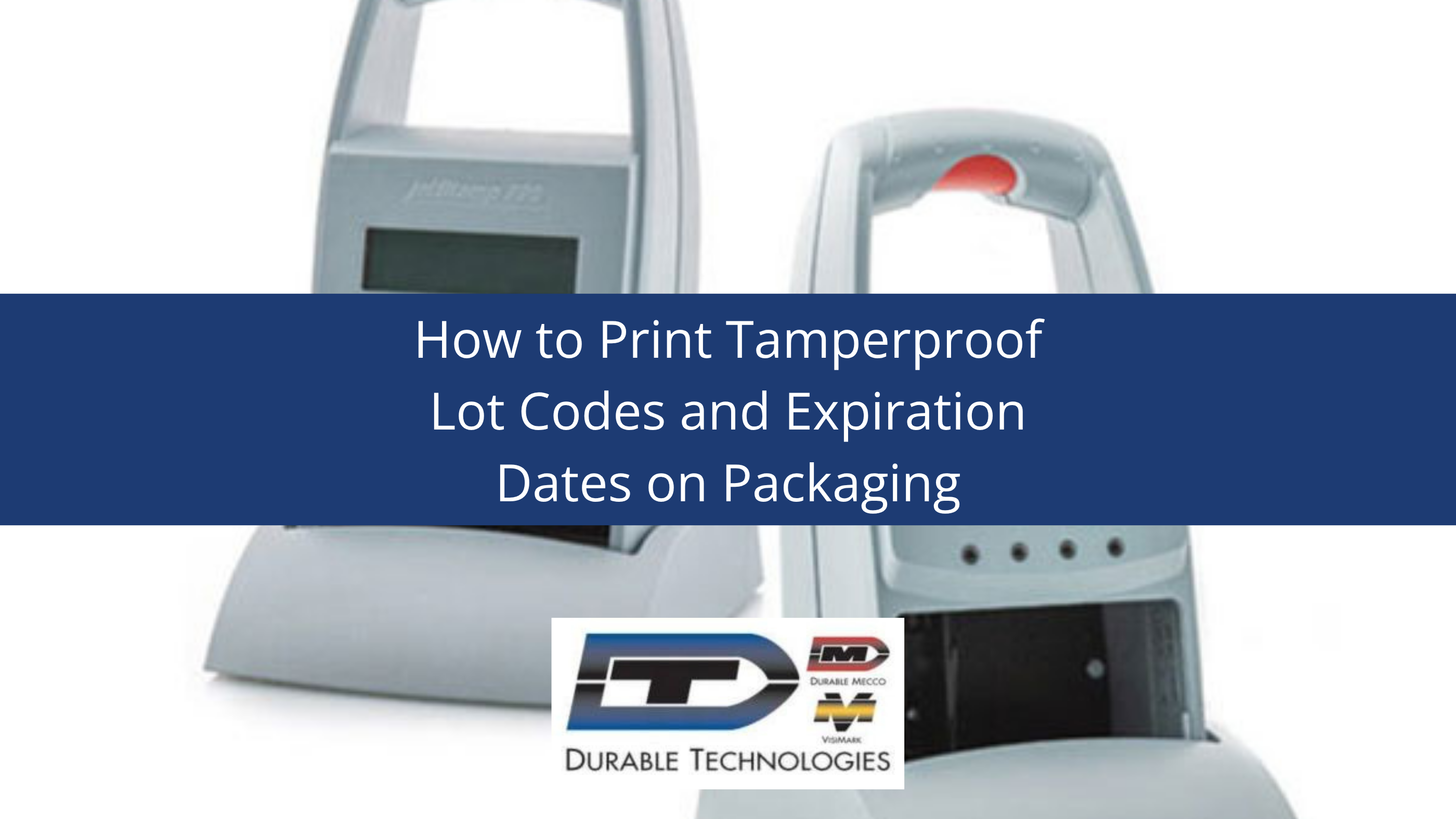
When a label fails international compliance, it is not just an inconvenience — it is a shipment rejection. A cosmetics company on the East Coast learned this when their handheld label applicator marks were flagged by regulatory authorities in the Middle East as non-permanent. Their lot numbers and expiration dates needed to be applied directly to the substrate. That meant no more labels. The jetStamp portable inkjet printer solved it in under one second per unit. This post covers how direct inkjet marking works for packaging date coding across cosmetics, food and beverage, cannabis, supplements, and other regulated industries.
Why Do Labels Fail International Compliance Requirements?
Labels applied over packaging are considered removable — and in many international markets, removable means non-compliant. Regulatory bodies in the Middle East, parts of the EU, and several Asia-Pacific markets require that lot numbers, batch codes, and expiration dates be applied directly to the primary substrate. A mark that can be peeled, soaked off, or repositioned does not meet the permanence standard.
This issue shows up most often when companies expand into new export markets after years of operating domestically without incident. A domestic label program that has worked fine for years hits a wall the moment product enters a jurisdiction with stricter traceability rules. The underlying problem is not the label itself — it is that adhesive-backed labels were never designed to function as serialized compliance marks. They were designed for branding and general identification.
Tamper proofing requirements go beyond permanence. In regulated categories like cosmetics, nutraceuticals, and cannabis, serialization is often required — meaning each unit must carry a unique, sequentially numbered code that cannot be replicated by simply reprinting a label. That level of control requires a computer-driven marking solution, not a hand-applied label.
What Makes Direct Inkjet Marking Tamperproof for Regulatory Purposes?
Direct inkjet marking is tamperproof because the ink bonds to the substrate surface rather than sitting on top of an adhesive layer. On non-porous substrates like plastic and glass, solvent-based MP inks penetrate slightly into the material or cure to a state that resists wiping, washing, and peeling. There is no label to remove — only a mark that is part of the package itself.
The distinction matters in regulated environments. When a lot code is printed directly onto a bottle or box, altering it requires physically defacing the packaging — which is both visible and traceable. A label, by contrast, can be replaced without any obvious evidence of tampering. That is why direct marking is increasingly specified by importers and regulators as the accepted method for expiration dates and batch serialization.
Computer-controlled printing adds another layer of integrity. Sequential numbering is generated programmatically, which means codes cannot be duplicated without access to the print system. For industries managing complex traceability chains — recall management in food and beverage, potency verification in cannabis, country-of-origin tracking in cosmetics — that audit trail is not optional.
Can One Printer Mark Plastic, Glass, and Cardboard in Under a Second?
Yes. The jetStamp portable inkjet printer can mark plastic bottles, glass containers, and paper or cardboard boxes in less than one second per unit, using the appropriate ink cartridge for each substrate type. There are ink formulas for printing onto porous substrates like paper and cardboard, and there are quick-dry solvent-based ink formulas for printing onto non-porous materials including plastic and glass.
The cosmetics company referenced above needed to mark across all three material types — plastic bottles, glass bottles, and corrugated cardboard boxes — within a single packaging operation. Before switching to the jetStamp, they were using a handheld label applicator that produced marks the Middle East's regulatory authorities rejected as non-permanent.
After switching, their results were direct: "These marks are not only tamperproof but look better from an aesthetic perspective than the previous labels. The cost per code is also lower than the hand applied paper labels." The consultative process mattered as much as the hardware. As the client noted, "Durable was a huge help in this process. They recommended the correct solution and provided samples of the marks on each of the materials we sent them. We intend to purchase more of the JetStamp printers in the future."
Cost per mark is a practical metric that often gets overlooked when evaluating marking solutions. Cartridges for the jetStamp 990 yield up to 5,000 impressions per 4mL cartridge. For companies running high-volume date coding, the per-unit cost of a direct inkjet mark is lower than most label programs once label stock, applicator maintenance, and labor are factored in.
Which Industries Rely on Portable Inkjet Printers for Lot Coding?
Any industry where traceability, serialization, or expiration date marking is required by regulation or customer demand is a candidate for direct inkjet coding. The jetStamp platform is in active use across a wide range of packaging environments.
Food and beverage is the largest category by volume. Best-by dates, lot codes, and production timestamps are regulatory requirements for most packaged food products. Portable inkjets are common in smaller food operations and contract packers where inline coding systems are cost prohibitive. The JetStamp handles this on glass jars, plastic containers, and corrugated cases without modification.
The cannabis industry has driven significant adoption of portable handheld inkjet printers, particularly as state-by-state serialization requirements have tightened. Compliance for THC, CBD, and hemp products now routinely requires unique batch codes, harvest dates, and test result references printed directly on primary packaging. The jetStamp 990 and the jetStamp Graphic 1025 are both deployed in cannabis packaging operations where flexibility and portability matter more than high-speed inline throughput.
Supplement and nutraceutical manufacturers face similar requirements. Lot codes tied to certificate-of-analysis records are standard for FDA-regulated dietary supplements. When contract manufacturers are producing dozens of SKUs across different product lines, a portable printer that can be reprogrammed quickly and moved between stations is often the most practical solution.
Cosmetics and personal care sit alongside nutraceuticals in terms of regulatory complexity. International export markets, particularly in the Middle East and parts of Asia, apply stricter permanence and serialization standards than the U.S. domestic market. Direct marking on the primary container is increasingly the only path to compliance.
What Are the jetStamp Technical Specs for Packaging Applications?
The jetStamp 990 is the current production model, replacing the earlier 790 and 792 series. It prints one or two lines of alphanumeric text, sequential numbering, and automatic date and time on both porous and non-porous substrates. Programming is done via USB or Bluetooth connection to a PC. The unit supports both rechargeable battery and plug-in power supply operation within the same unit, which gives it flexibility across different production environments.
Key specifications for the jetStamp 990:
- Ink cartridges available in black, red, and blue (blue limited to EM porous series)
- Up to 5,000 impressions per 4mL cartridge
- 1 or 2 lines of text; maximum 20 characters per line
- Maximum print width: 1.65 inches; character height: 1/8 inch with narrow, medium and bold fonts available
- Prints alphanumeric text, sequential numbering, and automatic date and time
- Weight: approximately 1 pound
- Dimensions: 6.5” H x 4” W x 3.5” D
For applications requiring barcodes, graphics, or a larger print area, the jetStamp Graphic 970 and jetStamp Graphic 1025 extend the platform's capability. The 1025 prints 1D and 2D barcodes, QR codes, and logos at 300 DPI resolution, with a print area up to 1 inch high by 3.5 inches wide. At 2.1 pounds with cartridge and batteries, it stays in the portable category while covering a much broader range of label replacement applications.
How Do You Choose the Right jetStamp Configuration for Your Application?
The substrate type is the first decision point. If you are marking paper, cardboard, or other porous materials, the EM series ink cartridges are the correct choice — these are water-based and designed to absorb into the material. For plastic, glass, coated cardboard, or any non-porous surface, the MP series quick-dry solvent ink is required. Using the wrong ink on the wrong substrate produces marks that smear or fail adhesion.
The second variable is print content. If your application requires only alphanumeric lot codes, expiration dates, and sequential numbering on one or two lines, the jetStamp 990 handles it. If you need barcodes, QR codes, or graphics — or if you are printing on large packaging surfaces like shipping cases — the Graphic 1025 is the more capable platform.
Power source matters in some environments. Battery operation is standard for all jetStamp models, but the 990 also supports a direct plug-in power supply, which makes sense for fixed-station coding at a packaging line. For field marking or highly mobile applications, battery-only operation is usually preferable.
If your application involves mixed substrates — like the cosmetics company that needed to mark plastic bottles, glass bottles, and cardboard boxes in the same operation — it is worth requesting print samples before committing to a configuration. Durable Technologies provides sample marks on customer-supplied materials as part of the evaluation process, which removes the guesswork around ink selection and print quality before purchase.