


A low-stress stamp marks a metal part without leaving a sharp notch behind. The characters are rounded or built from dots, so the impression has a soft bottom instead of a V.
That sounds like a small detail. On a turbine bracket, a drill pipe coupling, or a pressure fitting, it is the detail that keeps a part number from becoming the place a crack starts.
What is a low stress stamp?
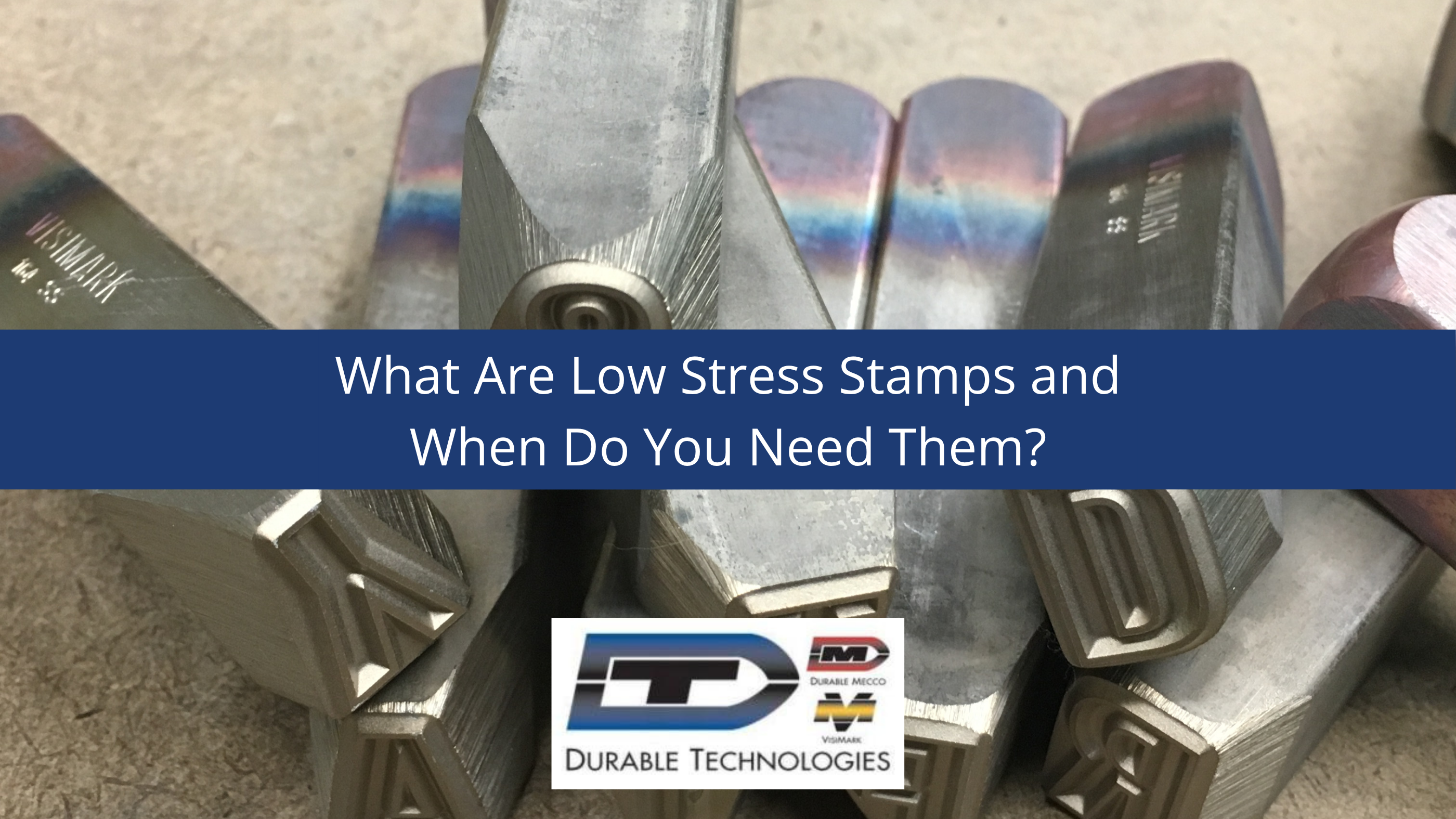
A low stress stamp is a steel marking tool whose characters have a rounded profile. When it strikes the part, it pushes the metal aside in a smooth trough or a row of shallow dimples. There is no knife edge at the bottom of the mark.
Durable Technologies makes two low-stress styles. Stress less full character stamps form each letter or number as a continuous round-face stroke. Stress less dot character stamps build each character from individual round dots. Both are made from the same cold-forged tool steel as our sharp face stamps, so they resist spalling and mushrooming through a long service life.
Both styles are available in the standard alphabet and numbers, in custom copy and logos, and in specialty forms like APIQ stamps and 3/8" buttress triangle handstamps for pipe.
Why can a sharp face stamp weaken a part?
A sharp face character is the most popular style for marking metal because it cuts a crisp, deep, readable impression with modest force. The same geometry that makes it easy to read is what makes it a problem on critical parts.
The bottom of a sharp face impression is a narrow V. Under load, stress piles up at the root of that V. Engineers call it a stress riser. On a part that flexes, vibrates, or cycles through pressure thousands of times, the root of a stamped character is a natural starting point for a fatigue crack.
A low-stress character spreads the same load across a radius, and the mark is still permanent.
Here is the practical test. If the part only needs to be identified on a shelf, sharp face is usually fine. If the part has to survive load cycles in service, and the print or your customer calls out low-stress marking, sharp face is off the table.
Low stress round vs. low stress dot: what is the difference?
Both styles reduce stress concentration. They differ in how they look, how much force they take, and where they fit best.
| Factor | Low stress round (full character) | Low stress dot |
|---|---|---|
| Character shape | Continuous stroke with a radiused bottom | Series of separate round dimples |
| Readability | Reads like a normal character, easy at a distance | Readable up close, lighter visual weight |
| Material displaced | More | Less |
| Force per character | Higher | Lower |
| Common uses | Aerospace part numbers, forgings, fittings | Thin-wall parts, tube and pipe, hardened material, parts where the least intrusion is required |
If your specification names one style, use that one. If it only says, "low stress," the choice usually comes down to wall thickness, material hardness, and how far away someone needs to read the mark.
Which industries require low stress marking?
Low stress marking shows up wherever a part failure is expensive or dangerous. Aerospace, oil and gas, and piping manufacturers specify it on many of their components. It also appears in power generation, defense, and pressure vessel work.
In aerospace, a stamped part number on a structural bracket or engine component must stay readable for the life of the part without affecting its fatigue performance. In oil and gas, APIQ stamps mark products built under American Petroleum Institute quality programs, and Durable Technologies makes them in sharp face, low stress round, and low stress dot. On pipe, our 3/8" buttress triangle stamps come in low stress full or dot characters so crews can line up connection points during assembly without notching the pipe body.
The rule that matters most is simple. Your drawing, purchase order, or customer's quality manual is the authority. When it calls for low stress marking, it will often name the character style, the minimum character height, the maximum depth, or the approved marking location. Match all of them.
How do you choose between sharp face and low stress?
Start with the part, not the stamp. Three questions settle most decisions.
Does the part carry load, pressure, or vibration in service? If yes, lean low stress. Does a drawing or customer spec name a character style? If yes, follow it. Is the part soft, thin, or already hardened? Dot characters often give the cleanest result with the least force.
| Your situation | Recommended style |
|---|---|
| Tooling, fixtures, stock, or parts that see no service load | Sharp face (Hevi-Bevl) |
| Aerospace, pressure-containing, or safety-critical parts | Low stress round or low stress dot, per spec |
| Thin wall tube or pipe | Low stress dot |
| Mark must read from several feet away | Low stress round in a larger character size |
| Partial impressions are likely on a curved or rough surface | 452-style font, available in low stress |
Not sure where your part lands? Send us the print. We make these stamps every day and we will tell you plainly which style fits.
Can you get low stress marks from a press or CNC machine?
Yes. Hand stamps are the right tool for low volume, but low stress characters are not limited to hand stamps.
Durable Technologies makes low stress round and low stress dot characters in steel type for type holders, in numbering head wheels for sequential serials, and in roll dies for marking round parts on a roll marking press or lathe. Roll marking is a good fit for tube and shafts, because the die rolls the mark onto the part instead of hitting it all at once.
For parts that are already fixtured in a machining center, the DuraDot marks with a low stress carbide stylus on materials up to 55 HRc, using the machine's existing engraving software. It is a popular choice in aerospace for exactly this reason. For serialization and 2D codes, dot peen marking systems create characters in precise low stress dot patterns on materials up to 62 HRc.
How do you get a clean low-stress mark by hand?
A round-bottom character does not bite into the metal the way a sharp face does. It takes a firmer, more deliberate blow to reach the same depth. Technique matters more.
Clamp the part so it cannot bounce. Use a hand stamp holder so your fingers stay clear, and a marking hammer sized to the character height. Set the stamp square to the surface and strike once with a firm, confident blow. A second hit almost always shifts the stamp and leaves a double impression, and on a low-stress part a double mark may not pass inspection.
If you are marking more than a few dozen parts a shift, or if depth has to be consistent from part to part, move the job to an impact press or roll marking press. The press delivers the same force every time. Your inspector will notice.
Low stress stamp FAQs
What is a low stress stamp?
It is a steel marking stamp with rounded or dotted characters instead of a sharp V-shaped face. The rounded impression spreads load over a wider area, so the mark does not create a sharp notch where a fatigue crack can start.
What is the difference between low-stress round and low-stress dot stamps?
Round (full character) stamps form each character as a continuous radiused stroke. Dot stamps form each character from separate round dimples. Dot characters displace less material and need less force. Full characters are easier to read at a distance.
Which industries require low stress marking?
Aerospace, oil and gas, and pipe manufacturers commonly specify it, along with any application where the part sees cyclic load, pressure, or safety-critical duty. Your drawing or customer specification is the final word.
Can low stress characters be used in a marking press or CNC machine?
Yes. Durable Technologies makes low stress characters in hand stamps, steel type, numbering head wheels, and roll dies. The DuraDot and dot peen systems produce low-stress marks on CNC and automated lines.
Is a low-stress stamp harder to use than a sharp face stamp?
It takes more force to reach the same depth. Use a holder and a marking hammer, strike once, and move to a press when volume or consistency demands it.
Have a print that calls for low-stress marking?
Send us the drawing or spec. We will match the character style, size, and marking method to your part and quote your low-stress stamps, type, or dies made to order. Call 866-344-7721 or contact Durable Technologies.