


The right date coding method is the one that puts a readable, permanent code on your package at the speed your line runs. That depends on three things: what material the package is made of, how many packages you need to code per shift, and what type of information is required.
Get those three right and the choice of equipment is usually obvious. Get one wrong and you end up with smeared codes on film, a printer that can't keep up, or a stamp that can't print a lot number that changes with every batch.
Quick answer: Use a manual ink date stamp for low volumes and simple dates. Use a hot foil coder for high-contrast codes on flexible film and labels. Use a portable inkjet printer when you need automatic dates, sequential lot numbers, or barcodes without a conveyor. Use inline continuous inkjet for small character date codes at production line speed and drop on demand or hi res for large characters and graphics on cases and corrugated.
What are the main ways to date code packaging?
Four methods cover almost every packaging operation we see. Here is how they compare side by side.
| Method | Best volume | Variable data | Typical packaging |
|---|---|---|---|
| Manual ink (rubber) date stamp | Low | Solid copy or changeable rubber bands | Cartons, labels, bags, bottles with the right ink |
| Hot stamp coder | Medium to high | Changeable metal type | Flexible film, pouches, label stock |
| Portable inkjet (JetStamp, HandJet) | Low to medium | Automatic date and time, serial numbers, barcodes on some models | Boxes, bottles, bags, glass, pallets, metal, wood |
|
Inline inkjet (CIJ, DOD or Hi Res) |
High, conveyor-fed | Full variable data, counters, 2D codes | Bottles, cans, film (CIJ), cases and corrugated (DOD and Hi Red) |
Which date coding method works on which packaging material?
Start with the material. It rules out more options than anything else.
Porous materials like corrugated, kraft paper, and uncoated cartons absorb ink. Almost any method works, and water-based inks are often fine. Non-porous materials like plastic bottles, glass, coated cartons, and metal cans need a fast-drying solvent-based ink or a foil. A water-based ink will sit on the surface and smear the first time someone handles the package.
Thin plastic film is the tricky one. Most food and consumables packaging is film, and it is where the wrong method fails fastest. An ink stamp needs a non-porous ink made for film. A heated die pressed onto thin film by hand will burn right through it. A hot foil coder designed for packaging film controls the heat, pressure, and dwell time, and the foil bonds to polyethylene, polypropylene, polyester, nylon, and cellophane without melting through.
When is a manual ink date stamp enough?
A manual date stamp is the simplest and cheapest way to code a package. Adjustable bands carry the month, day, and year. A two-band stamp, for example, can carry 1 to 12 on one band and 1 to 31 on the other. Custom wrap bands add fixed text like BEST BY, EXP, or LOT.
It is the right tool when you have to date code a few dozen to a few hundred packages a day and the date changes once a day at most. Small food producers, farm stands, specialty bakeries, and short-run contract packers use them every day.
Where it stops working: sequential lot numbers, barcodes, and anything that is variable from package to package. Speed maxes out at how fast the operator's hands can move. And the ink has to match the material being printed on, so use a non-porous ink on plastic, glass, or coated stock.
When does a hot foil coder make sense?
A hot foil coder uses heated metal type to press a pigmented foil ribbon (or ink roll if you have a touch dry coder from Markem-Imaje) onto the package. The result is a sharp, high-contrast code that resists abrasion and does not smear, because there is no wet ink to dry.
Foil coders are a common choice on flexible packaging lines and label stock. The type and logos are changeable, so the date and lot code can be updated for each shift or batch. Durable Technologies supplies the replacement metal date coding type for all of the popular OEM equipment, as well as the foil ribbons, including Norwood 172 and 987 black formulations, 273 white, and more depending on the application requirements .
The trade-off is flexibility. A foil coder prints what the type says. If every package needs a unique serial number or a barcode, you need inkjet.
When should you move to a portable inkjet printer?
Move to a portable inkjet printer when the code has to change or update on its own. Automatic date and time, sequential lot numbers, and barcodes are where handheld stamps run out and portable printers take over.
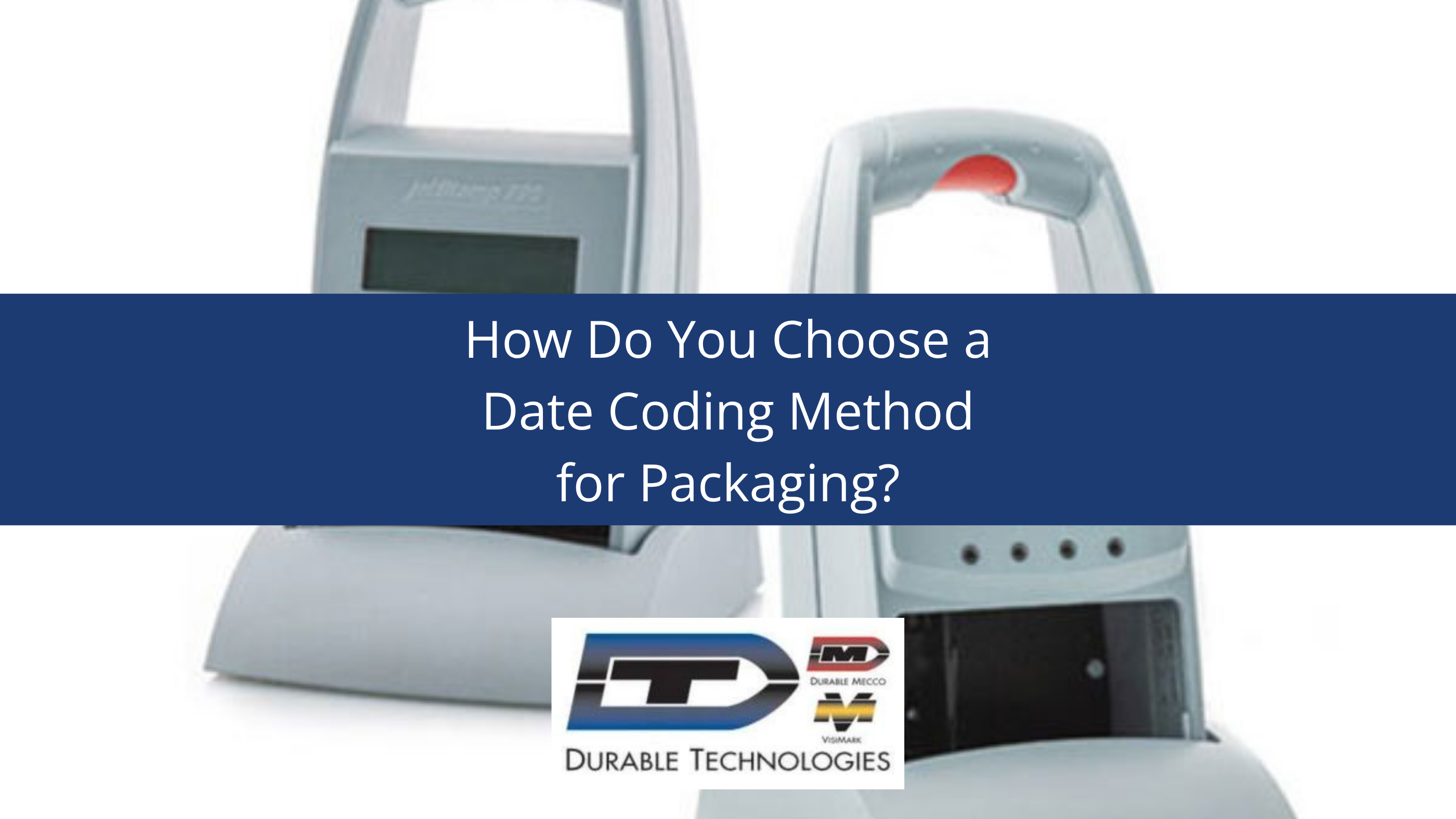
The JetStamp line prints alphanumeric text, sequential numbering, and automatic date and time on porous and non-porous surfaces. The JetStamp Graphic 1025 prints text, 1D and 2D barcodes, QR codes, and graphics at 300 DPI in an area up to 1" high by 3-1/2" long and weighs 2.1 lbs. with the cartridge and batteries. Its self-traversing printhead moves across the surface while the printer sits still, so it codes bottles, bags, pouches, and boxes that won't roll under a printer. The HandJet 250 and 260 handle larger characters on cases, pallets, lumber, and metal.
One cosmetics company on the East Coast needed this exact step up. It was coding lot numbers and expiration dates on skin care bottles with a handheld label applicator. Regulators in the Middle East, one of its export markets, did not consider applied labels permanent. The codes had to go directly on plastic bottles, glass bottles, and paperboard cartons, and serialization meant a computer-controlled printer. The company now codes each bottle and box in under one second with a JetStamp portable inkjet printer.
"These marks are not only tamperproof but look better from an aesthetic perspective than the previous labels. The cost per code is also lower than the hand applied paper labels."
The customer also noted that Durable Technologies printed samples on each of the materials they sent in before recommending a printer. Ask for that. It is the best way to ensure that a printed code will hold up on your package.
When do you need an inline inkjet printer?
You need an inline printer when packages move past on a conveyor faster than anyone could code them by hand. There are two types, and they solve different problems.
Continuous inkjet (CIJ) is built for applying date codes using small characters at speed. Durable's CIJ printers print 1 to 4 lines, with message heights from 1 to 20 mm (.040" to .788"), at up to 1,666 characters per second on a single line and up to 160 m per minute (525 fpm) on twin line. They print expiration dates, lot codes, counters, logos, and 2D data matrix codes on bottles, cans, film, and irregular shapes. Because the ink stream runs continuously, the nozzles are less prone to clogging, and the printhead can sit farther from the package.
Drop on demand (DOD) fires ink only when it is needed and is built for large characters. It is the usual choice for case coding on corrugated boxes and trays, and it also prints on plastics, metals, paper, and foils.
High resolution (Hi res) is ideal for printing high-resolution text, barcodes, and graphics onto secondary packages.
A simple rule of thumb: CIJ for the primary package the consumer holds, DOD and/or Hi res for the case it ships in.
Why replace date code labels with direct printing?
Labels are easy to start with and hard to live with. They cost money per piece, they take labor to apply, and they can be peeled off. For some regulators and retailers, that last point alone disqualifies them.
Printing the code directly on the package removes the label cost, removes the application step, and makes the code part of the package. In the cosmetics example above, the switch also lowered cost per code. Your numbers will depend on volume, ink or foil use, and labor, so run them on your own line before you decide.
Package date coding FAQs.
What is the cheapest way to put expiration dates on packaging?
A manual ink date stamp with adjustable month, day, and year bands. It suits low volumes coded by hand. Use a non-porous ink on plastic, glass, or coated stock.
Can you hot stamp an expiration date on plastic film?
Yes, with a hot foil coder built for packaging film and a foil formulated for it. The coder controls heat, pressure, and dwell so the foil transfers cleanly. A heated die pressed onto thin film by hand is where burn-through happens.
When should I use a portable inkjet printer for date coding?
When you need automatic dates, sequential lot numbers, or barcodes but have no conveyor to mount a printer on. JetStamp and HandJet printers code porous and non-porous surfaces and are programmed from a PC.
What is the difference between continuous inkjet, drop on demand, and hi res for packaging?
CIJ prints small codes at high line speed on bottles, cans, and film. DOD prints large characters on cases, trays, and corrugated boxes. Hi res prints high resolution images onto secondard packaging.
Are printed date codes permanent enough for regulators?
Codes printed directly on the package are generally treated as more permanent and tamper-resistant than applied labels. Requirements vary by product and country, so confirm what your regulator or customer requires.
Not sure which method fits your package?
Send us a few samples of your packaging. We will print test codes on each material and recommend the method that fits your volume and data. Call 866-344-7721 or request a free print sample.
Related reading: Industrial Inkjet Printers · Hot Stamping Coders · Continuous Inkjet Printers