




Amy Bruecks of City Carbonic Sales & Service in Oklahoma City, Oklahoma, had a safety problem that most cylinder requalification shops recognize. The hand stamps her crew used to mark compressed gas cylinders were mushrooming at the struck end, shedding fragments, and injuring employees.
Quick Answer: Marking a cylinder safely comes down to two things: the stamp must be made from heat treated tool steel for repeated hammer impact, and the operator's hand must be kept out of the hammer's strike zone. Get both right and the mark can meet applicable 49 CFR requirements without putting the operator at unnecessary risk.
What does 49 CFR require on a requalified cylinder?
Under 49 CFR 180.213, a successfully requalified cylinder must carry the requalification date and the requalifier's four-character Requalifier Identification Number (RIN). When applicable, the mark also includes a symbol identifying the test performed. Requalification marks must be placed on the metal at the upper end of the cylinder, and sidewall marking is prohibited unless the applicable cylinder specification authorizes it. Most requalification markings must be at least 1/4 inch high; RIN characters must be at least 1/8 inch high.
City Carbonic requalifies and refills compressed gas cylinders for fire departments, welding shops, SCUBA, paintball, medical, and aviation customers. The cylinders are steel or aluminum. Each one is marked along the tapered crown section so the next person to handle it can read the requalification date without hunting for it.
That crown is a curved, hardened surface, and it is unforgiving. Leaving a clean 1/4 inch impression takes a square hit, and the impact travels straight back up the stamp shank into the struck end.
Why do steel hand stamps mushroom and throw fragments?
Hand stamps mushroom when the struck end of the shank is too soft for repeated impact, and they chip when that end is too hard or poorly tempered. A soft end spreads and curls outward into a mushroom. A brittle end fractures and throws pieces. Both problems point to improper material selection or heat treatment, and on a high-volume line they can show up within weeks rather than years.
Volume exposes the difference. A shop marking a few dozen parts a month may never see it. A requalification line running the same year stamp all day sees it quickly.
“We will mark up to 26,000 cylinders per year with the year hand stamp so it must be able to withstand that many impacts. Our previous stamps would mushroom at the hammer impact point and in some cases, pieces would break off and fly around like shrapnel causing a very unsafe and unacceptable working condition.”
Amy Bruecks, City Carbonic Sales & Service, Oklahoma City, Oklahoma
Durable Technologies hand stamps are made from tool steel and heat treated so the working face stays sharp and the struck end stays intact through the repeated impacts of a cylinder requalification line.
How does a safety stamp holder protect the operator's hand?
A safety stamp holder puts a steel body and a guard between the hammer and the operator's fingers. The steel hand stamp seats inside the holder, the operator grips the handle away from the strike zone, and a missed swing lands on the holder instead of the hand. The holder also helps keep the stamp square to the part, producing a more legible mark.
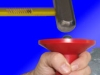
Several grip styles are available depending on the part and the operator. The Safety First Stamp Grip shields the hand while the stamp is being struck. On a curved cylinder crown, it also helps hold the stamp face flat against the taper so it cannot rock under the hammer.
City Carbonic paired the Durable Technologies Safety First Stamp Grip with Durable Technologies hand stamps.
What changed for City Carbonic after they switched?
City Carbonic replaced its hand stamps and put every stamp in a safety grip. The mushrooming stopped, as did the flying fragments. Mark quality improved, the stamps lasted longer, and the crew stopped sustaining hand injuries on a line that marks up to 26,000 cylinders a year.
“These types of holders along with the higher quality hand stamps from Durable Technologies have completely eliminated the mushrooming and shrapnel issues for our employees. Our mark quality is better, our process is safer, and we save money on replacement stamps. Durable Technologies has delivered the best hand stamp products we have seen.”
Amy Bruecks, City Carbonic Sales & Service, Oklahoma City, Oklahoma
“We were tired of having employees hurt and needed to find a supplier that made a product that could mark the cylinders as per the regulations without causing injuries to our employees,” Bruecks said.
Frequently asked questions about cylinder hand stamps
Where do requalification marks go on a compressed gas cylinder?
Requalification marks may be placed on the metal at the upper end of the cylinder, excluding the sidewall. Marking the sidewall is prohibited unless the applicable cylinder specification authorizes it.
What character size does 49 CFR require for requalification marks?
Most requalification markings must be at least 1/4 inch high, while the four RIN characters must be at least 1/8 inch high. The RIN is arranged in a square pattern between the month and year of the requalification date.
Can you use a standard steel hand stamp on a DOT 3HT cylinder?
When a DOT 3HT cylinder is stamped, 49 CFR 180.213 requires the test date and RIN to be applied with low-stress steel stamps. The impression may be no deeper than the depth prescribed when the cylinder was manufactured, and stamping the sidewall is not authorized.
Does a safety stamp holder slow down a high-volume marking line?
A safety stamp holder should not slow a high-volume marking line. The stamp seats in the holder and stays there for the run, so the operator places and strikes it much as before. The holder can also help keep the stamp square on a curved crown, reducing second strikes and rejected marks.
What causes a hand stamp to mushroom at the struck end?
Mushrooming occurs when the struck end of the shank is too soft for the repeated hammer impact. The steel deforms and spreads outward with every hit until a lip forms. Pieces can eventually break loose from that lip. A stamp made and heat treated for repeated impact is designed to hold its shape through a high number of strikes.
Are hand stamps or dot peen systems better for cylinder requalification?
Hand stamps make sense for shops marking cylinders at moderate volume or in multiple locations because the tooling cost is low and no power is required. Dot peen equipment can make sense at higher volumes with consistent part handling or a need for variable data. The correct method depends on the cylinder specification and all applicable marking requirements, as well as volume and budget.
Talk through your cylinder marking requirements
Durable Technologies has been making steel stamps and related marking products since 1889. That process and materials experience helps to ensure that your parts are marked legibly, consistently, and safely.
Tell us the cylinder specification, the character height you need, and how many cylinders you mark each year. We will recommend the hand stamps and stamp holders built for your duty cycle.